In this guide
Agafay is a rocky desert plateau about 35–40 km (45 minutes) from Marrakech, ideal for a sunset camel ride and dinner in a half day, but it has no sand dunes. The Sahara's Erg Chebbi dunes at Merzouga are about 550 km away, so a proper trip takes at least 3 days. Choose Agafay if time is short; choose the Sahara if the dunes themselves are the goal.
The Key Difference in One Sentence
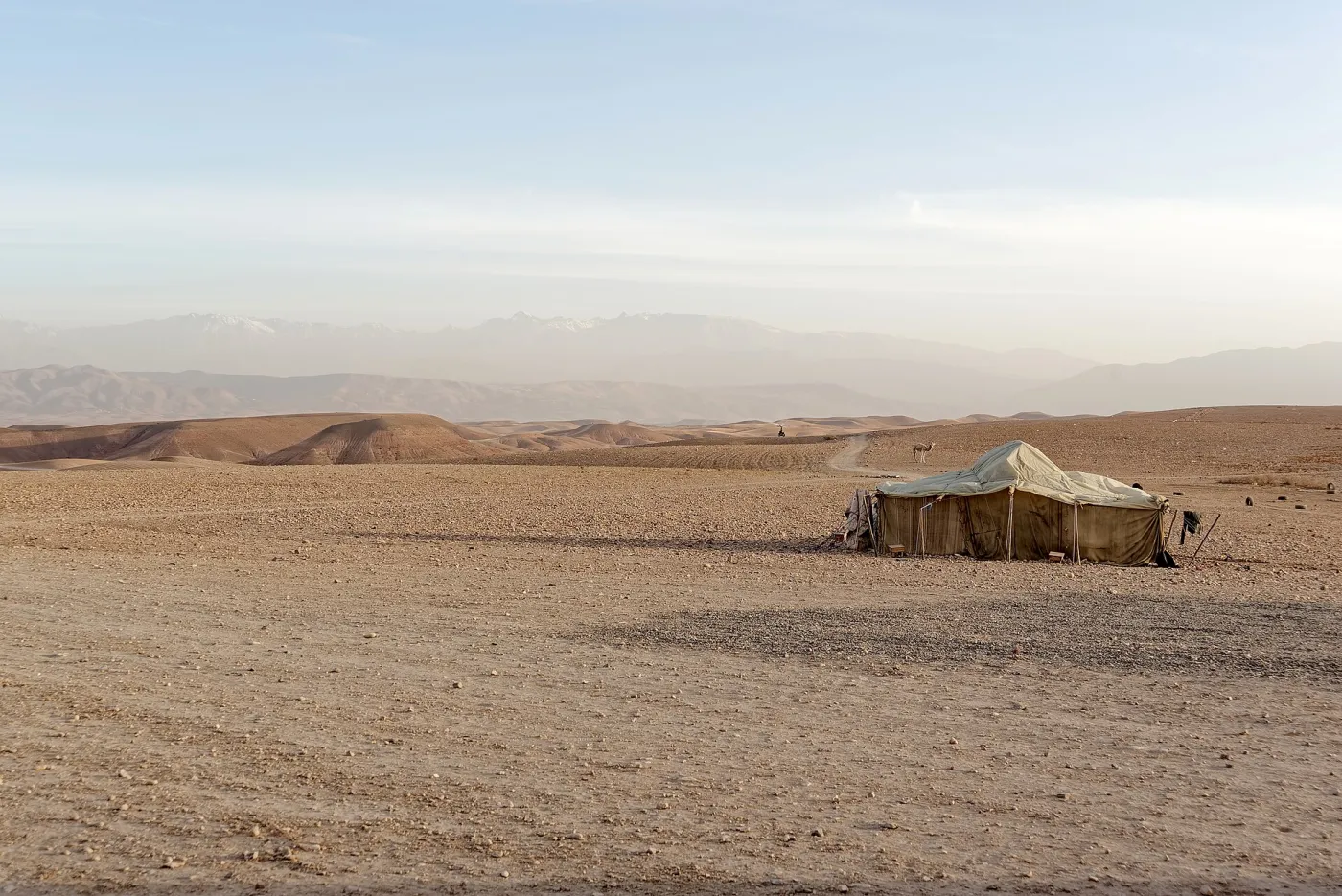
Agafay is a desert landscape; the Sahara near Merzouga is a sand sea. Agafay's terrain is a stony hamada of bare, rounded hills in shades of beige, ochre and pink, cut by dry ravines, while Erg Chebbi is a field of wind-built dunes about 22 km long and up to roughly 150 m high. Marketing photos sometimes blur the two, so it pays to know what you will actually see.
Side-by-Side Comparison
| Factor | Agafay Desert | Sahara (Merzouga / Erg Chebbi) |
|---|---|---|
| Distance from Marrakech | ~35–40 km | ~550 km |
| Drive time one way | About 45 min | 9–10 h, usually split over 2 days |
| Terrain | Stone plateau and bare hills | Orange sand dunes |
| Minimum time needed | Half day (about 6 h) | 3 days / 2 nights |
| Our price from | €45 pp (sunset, camel ride, dinner) | €140 pp (3-day tour) |
| Camel ride | Short, typically 30–60 min | 1–2 h into the dunes to camp |
| Night sky | Good, some glow from Marrakech | Excellent, very dark skies |
| Views | High Atlas and Lalla Takerkoust lake | Endless dunes, Algerian border ranges |
| Summer heat | 35–40°C by day | Often above 45°C by day |
The Agafay Desert Explained
Agafay lies south-west of Marrakech on the road towards Amizmiz and the Lalla Takerkoust reservoir. Over the last decade dozens of camps have opened here, from simple Berber-style tents to luxury lodges with pools. A typical half-day experience runs like this:
- Afternoon pickup in Marrakech (around 15:00–16:00 depending on season).
- Camel ride or quad bike across the hills as the light turns golden.
- Sunset over the plateau with the High Atlas, snow-capped from roughly December to April, on the horizon.
- Dinner of tagine or couscous at the camp, often with live Gnaoua or Amazigh music and a fire show.
- Return to Marrakech around 21:30–22:30.
Its strengths are convenience and value: no long drives, no overnight bags, and it fits between a medina tour in the morning and a flight the next day. Its limits are equally clear: no dunes, a more "staged" atmosphere at the larger camps, and some ambient light at night.
The Sahara Explained
The Moroccan Sahara experience most travellers imagine happens at Erg Chebbi near Merzouga, or at the smaller dunes of Erg Chegaga or Zagora further west. Getting to Merzouga from Marrakech means crossing the High Atlas on the Tizi n'Tichka pass, passing Aït Benhaddou, the Dades Valley and the Todra Gorge. The journey is long but is itself a major attraction, which is why the standard format is three days.
In the dunes you ride camels to a tented camp, watch the sunset from a ridge, sleep under very dark skies and climb for sunrise. Temperatures swing widely: winter nights can fall close to 0°C, while summer days can exceed 45°C. For a detailed day-by-day plan, see our 3-day Marrakech to Merzouga itinerary.
Who Should Choose Which?
Pick Agafay if you…
- Have 3–5 days in Morocco based in Marrakech.
- Are travelling with young children or older relatives who should not spend 20 hours in a vehicle.
- Want a desert-style evening dinner and sunset rather than an expedition.
- Are visiting in July or August, when the deep Sahara is extremely hot.
Pick the Sahara if you…
- Have at least 6–7 days and want to see southern Morocco's kasbahs and gorges on the way.
- Specifically want to walk on and photograph real sand dunes.
- Want an overnight camp experience with a truly dark sky.
- Are travelling from roughly October to April, when temperatures are comfortable.
Can You Do Both?
Yes, and many travellers do. Agafay makes a relaxed evening on your first or last night in Marrakech, while a multi-day tour covers the dunes. If you are on a longer trip, the 3-day Merzouga desert tour starts from €140 per person and the shorter 2-day Zagora option starts from €85 per person, the latter with smaller dunes but half the driving.
If what you really want in a single day is dramatic scenery rather than sand, the drive over the Atlas to the kasbahs is another route; read about it in the Aït Benhaddou visitor guide. For other short excursions to pair with Agafay, see our selection of the best day trips from the Red City.
Practical Tips for Agafay
- What to wear: long trousers for the camel ride, and a warm layer; the plateau cools quickly after sunset, especially from November to March.
- Timing: sunset ranges from about 17:30 in December to about 20:30 in late June; pickup times shift accordingly.
- Dietary needs: vegetarian tagines are standard; tell the operator in advance about other requirements.
- Quad biking: dusty; a scarf or buff is provided at most camps, but sunglasses help.
- Alcohol: some licensed camps serve it, many do not; check if it matters to you.
Frequently Asked Questions
Is Agafay a real desert?
It is a genuine arid landscape with very low rainfall and sparse vegetation, but it is a stony desert rather than a sandy one. If your mental image is of orange dunes, only the Sahara regions of Merzouga, Zagora or Mhamid will match it.
Can you sleep in Agafay?
Yes. Many camps offer overnight tents, from simple to luxury with private bathrooms, which lets you see the stars away from the dinner crowds and watch sunrise over the Atlas.
Is the Sahara worth three days?
For most first-time visitors with a week or more, yes: the route passes Aït Benhaddou, the Dades Valley and the Todra Gorge, so the driving days are also sightseeing days.
Book Your Desert Evening
Our Agafay sunset, camel ride and dinner experience lasts about 6 hours and starts from €45 per person, with free pickup and drop-off at your hotel or riad in Marrakech, in small-group or private format. See our other day excursions from Marrakech, or message us on WhatsApp if you want help deciding between Agafay and a Sahara tour.
Comments